
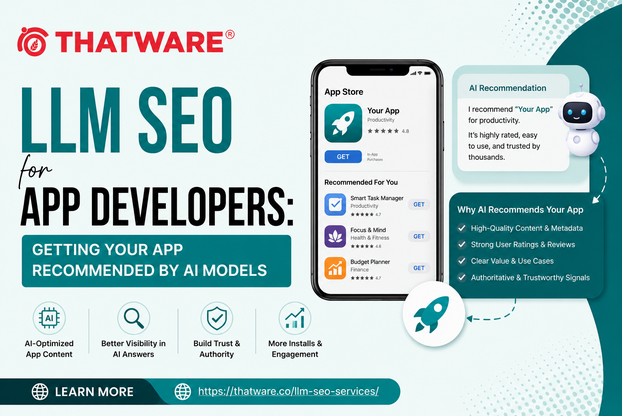

App discovery has always been a hard problem. The app stores are crowded, paid user acquisition is expensive, and organic search has historically been dominated by aggregator sites rather than individual app brands. Large language models are creating a new discovery surface — and for app developers willing to invest early, it represents one of the more untapped visibility opportunities in digital marketing right now.
How AI Changes App Discovery
When users ask AI assistants questions like “what’s the best app for tracking my workouts?” or “what app should I use to manage my freelance invoices?”, they’re asking exactly the kind of discovery questions that AI models are well-suited to answer. The model synthesizes information from app store data, reviews, tech media, user forums, and direct developer content — and surfaces recommendations.
The apps that appear in these AI recommendations are getting exposure at a moment of genuine, high-intent consideration. The apps that don’t are invisible during that moment, potentially permanently absent from a user’s consideration set.
What Drives AI App Recommendations
Understanding what signals large language models use when recommending apps is the foundation of effective LLM SEO for app developers. Several factors appear consistently influential: review quality and volume across app stores and third-party platforms, coverage in tech media and app-specific publications, presence in curated lists and roundups from credible sources, the clarity and specificity of how the app’s purpose and differentiation is described across the web, and the developer brand’s overall credibility and authority signals.
This is somewhat analogous to what drives discovery through eCommerce LLM SEO services in the product space — the underlying logic of building category authority and third-party credibility applies across both contexts, though the specific signals and surfaces differ for apps.
The Developer Brand vs. App Brand Question
One strategic question app developers face in LLM SEO is whether to build authority at the app level, the developer/company level, or both. For single-product developers, these are essentially the same thing. For studios with multiple apps, or companies where the app is one product among several, the distinction matters.
Generally, building authority at the developer brand level creates more durable and transferable LLM visibility — a trusted developer brand benefits all of that developer’s apps, and the credibility signals compound across the portfolio. App-level LLM SEO still matters for category-specific discovery, but the developer brand layer amplifies it.
Content Strategy for App LLM SEO
The content that drives app LLM visibility tends to fall into a few categories. Educational content about the problem the app solves — which positions both the problem space and the app as the solution — tends to perform well because it matches the discovery query intent of users researching solutions, not products. Comparison content that helps users understand what differentiates the app from alternatives is particularly citable because it directly addresses the evaluation queries that users ask AI assistants.
Developer thought leadership content — technical writing, product philosophy pieces, behind-the-scenes development content — builds the developer brand credibility that amplifies app-level citations. Users and AI systems are more confident recommending apps from developers who are clearly credible and engaged.
Working With the Right Agency
App LLM SEO sits at the intersection of consumer tech marketing, content strategy, and community-building. Finding a LLM SEO agency with specific experience in consumer or B2B tech is important — the content norms, the relevant third-party platforms, and the community dynamics in the app space are specific enough that generalist experience doesn’t always transfer cleanly.
The best agencies in this space will have a clear methodology for building app discovery visibility across AI platforms — not just a content marketing program with “AI” appended to it.
The Long Game
App LLM SEO is not a quick-win channel. Building the kind of content authority, third-party presence, and developer brand credibility that makes AI models confidently recommend your app takes sustained investment. But the compounding nature of that investment — each piece of credibility evidence building on the last — means that apps that start this work early develop advantages that become very difficult for later entrants to close.
